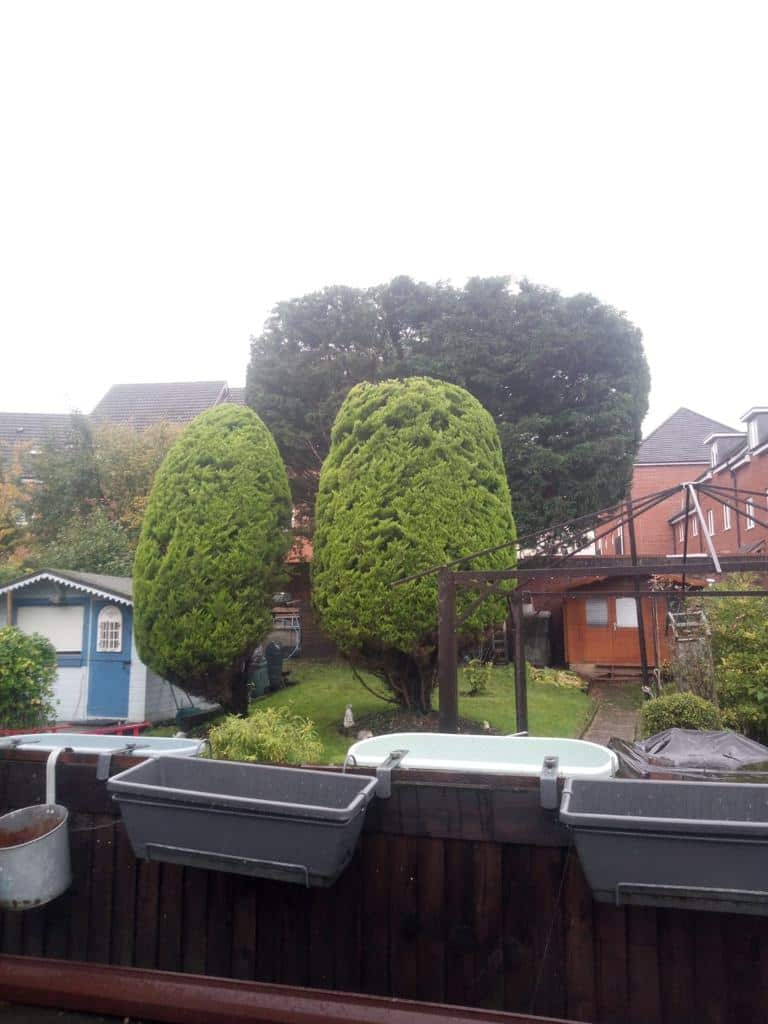
Trees and hedges often perform very different roles within a garden, but their growth can become closely connected. A mature hedge may provide privacy and define the boundary, while nearby trees provide height, character and established greenery. As both continue growing, however, the combined canopy can become dense, reduce available light, restrict access and make the garden feel considerably smaller.
In these circumstances, cutting the hedge alone may not provide the improvement expected. Equally, pruning a tree without considering the surrounding hedge can leave much of the original congestion unchanged. Where both are contributing to the problem, coordinating hedge cutting with appropriate tree surgery can produce a more balanced and practical result.
For homeowners in Sawston, Cambridge, the key is to understand which growth is causing which problem. Professional assessment can identify whether the hedge needs trimming or reducing, whether nearby trees require selective pruning, and how the work can be planned without removing more healthy growth than necessary.
When Should Hedge Cutting and Tree Surgery Be Considered Together?
Hedge cutting and tree surgery can be worth considering together when trees and hedges have developed into the same space or when both are contributing to excessive shade, restricted access, overhanging growth or a generally congested garden.
The work does not necessarily need to be extensive.
A hedge may simply require a controlled reduction while selected tree branches are shortened or removed. In other situations, a larger tree crown and an overgrown hedge may both need more structured management.
The objective should be to understand the garden as a complete space rather than treating every plant independently.
When the Garden Has Become Heavily Enclosed
A mature hedge can provide valuable screening, but when combined with large trees it may create a very enclosed garden.
The hedge occupies space around the perimeter while tree crowns extend overhead, reducing the amount of open space both visually and physically.
Cutting back only one element may provide limited improvement.
Managing the hedge dimensions alongside appropriate tree pruning can help create a more open garden while retaining established greenery.
When the Hedge and Tree Canopies Have Grown Together
Over time, branches from nearby trees can extend directly into or above a hedge.
The two canopies may eventually become difficult to distinguish.
This creates practical challenges when carrying out routine hedge maintenance because tree branches may be growing through the area that would normally be trimmed.
Professional assessment can identify which growth belongs to the hedge and which branches form part of the tree.
The tree can then be pruned appropriately before or alongside the hedge work where necessary.
When a Hedge Has Become Too Tall Beneath Trees
Tall hedges can become particularly dominant where tree crowns are already occupying the space above them.
The combined height can create a continuous wall of vegetation.
Reducing the hedge to more manageable dimensions may improve the situation, but the result can still feel heavily enclosed if substantial tree branches remain directly overhead.
Assessing both forms of growth provides a clearer picture of what actually needs to change.
When You Want More Light in the Garden
Lack of light is one of the most common reasons for considering both hedge cutting and tree surgery.
A dense hedge can block light from lower angles while tree crowns intercept it from above.
If both contribute significantly to shade, managing only one may not create the expected improvement.
The first step should be identifying where the shade originates.
Appropriate hedge reduction combined with carefully selected tree pruning may improve light levels without requiring drastic work to either.
More Cutting Does Not Automatically Mean More Light
When a garden feels dark, removing large amounts of greenery can seem like the obvious solution.
However, the location of the growth matters more than simply the quantity removed.
Reducing a section of hedge that has little influence on the shaded area may make very little difference. The same applies to pruning tree branches that are not responsible for the relevant shade.
Professional assessment can identify the sections of hedge and tree canopy that have the greatest influence on the garden.
This makes the work more targeted.
When You Want to Keep Privacy but Reduce Overgrowth
A hedge may be deliberately retained because it provides valuable privacy.
The problem is that allowing it to grow indefinitely can eventually make the garden difficult to manage.
At the same time, nearby trees may add additional screening at higher levels.
The solution does not necessarily involve heavily reducing everything.
Controlled hedge cutting can retain useful density while selective tree surgery manages branches that have become excessive.
This can provide a better balance between privacy and usable garden space.
When Paths Are Becoming Narrow
Hedges frequently spread beyond their original dimensions as side growth develops.
Where trees also have low branches extending into the same area, a garden path can gradually become noticeably narrower.
Cutting the hedge may restore some width, but low tree growth can continue restricting movement.
In these situations, hedge cutting and selective tree pruning can be coordinated around the clearance actually required.
The rest of the vegetation can remain largely unchanged.
When Garden Access Is Becoming Difficult
The same issue can occur around frequently used access routes.
Low branches, outward-growing hedge shoots and dense vegetation can make movement through the garden awkward.
Rather than repeatedly trimming whatever happens to be in the way, it can be more useful to assess the underlying structure.
The hedge may require reshaping while selected tree branches need shortening, removal or lifting.
This provides a more considered approach to restoring access.
When Trees Are Growing Directly Above the Hedge
Trees positioned close to a boundary often develop branches above established hedging.
As these branches become larger, they can create a second canopy over the hedge.
This may increase shade and make hedge maintenance more awkward.
Selective tree pruning can sometimes create more separation between the two layers of vegetation.
Where appropriate, this can make the hedge easier to maintain without requiring unnecessary pruning throughout the rest of the tree.
When Tree Branches Are Growing Through the Hedge
Branches can sometimes grow directly through the body of a hedge.
Once this happens, simply trimming the visible ends may not provide a lasting solution.
The branch may continue extending from within the hedge and produce further secondary growth.
A tree surgeon can assess where the branch originates and whether shortening or removing it at a more appropriate point would provide a better result.
The surrounding hedge can then be managed separately.
When a Hedge Is Competing for Space With Lower Tree Branches
Trees and hedges can occupy the same vertical space.
Lower tree branches may spread across the upper part of a hedge while the hedge continues growing upwards into the tree canopy.
This creates increasingly congested growth.
Depending on the tree, selective pruning or crown lifting may create more defined separation.
The hedge can then be maintained at dimensions that suit the available space.
Crown Lifting Can Improve Clearance Above Hedges
Crown lifting involves managing appropriate lower branches to increase clearance beneath the tree canopy.
Where suitable, it can be useful when low tree branches repeatedly interfere with a hedge or garden access.
The technique does not necessarily reduce the overall height of the tree.
Instead, attention is focused on lower parts of the crown.
This can make it useful where the main problem is interaction between low branches and established hedging.
Crown Reduction May Help With a Large Overhanging Canopy
If the tree’s overall crown has become too extensive, crown reduction may sometimes be more appropriate.
This technique selectively reduces the height or spread of the canopy while retaining a suitable branch structure.
Where a large crown extends significantly over an already substantial hedge, a proportionate reduction may help create more manageable dimensions.
The amount of pruning should be based on the species, condition and structure of the tree rather than simply matching the dimensions of the hedge.
Selective Pruning May Be All the Tree Needs
Not every situation involving an overgrown hedge requires substantial tree surgery.
Sometimes only a few branches are responsible for the conflict.
Selective pruning can target those branches while leaving the majority of the tree unchanged.
This is particularly useful where the tree is otherwise well suited to the garden.
Professional tree surgery should always consider whether a localised solution can achieve the objective before recommending broader crown work.
Hedge Reduction Is Different From Routine Hedge Trimming
Routine hedge cutting generally focuses on maintaining an established shape and controlling relatively recent growth.
A hedge that has become substantially too tall or wide may require a more considered reduction.
The distinction matters when coordinating hedge work with tree surgery.
If the hedge requires only light trimming, the effect on the overall garden may be modest. If its dimensions need to change significantly, this can influence how much tree pruning is genuinely necessary.
Looking at both together helps avoid overcorrecting the problem.
Mature Hedges Need Careful Management
A large established hedge can represent many years of growth.
Reducing it excessively in a single attempt is not always the most appropriate approach.
The species, density and existing condition should influence how the hedge is managed.
Where trees are also being pruned, there can be a temptation to transform the entire garden at once.
A proportionate approach considers how each element is likely to respond and avoids removing unnecessary healthy growth.
Different Hedge Species Respond Differently to Cutting
Not every hedge responds to reduction in the same way.
Some tolerate substantial cutting and regenerate readily, while others require more careful management.
This affects how far the hedge can realistically be reduced and what appearance can be expected afterwards.
The tree species also matters.
Considering both types of vegetation individually allows the overall garden management plan to be more appropriate.
Tree Species Influences the Pruning Approach
Different trees have different natural crown structures and responses to pruning.
Some produce vigorous new growth after heavy reduction, while others are better managed through more selective intervention.
This is important when trees are growing alongside hedges.
Removing excessive tree growth simply to create a temporary gap may result in rapid regrowth that recreates the original problem.
Professional pruning considers how the tree is likely to develop after the work.
Future Growth Should Be Considered
Neither a hedge nor a tree stops growing after it has been cut.
A useful garden management plan should therefore consider what happens next.
If the hedge is reduced but allowed to immediately regain excessive dimensions, the original congestion will return.
Likewise, poorly planned tree pruning may encourage dense regrowth into the same space.
Thinking about future development helps establish more manageable dimensions for both.
When the Garden Feels Smaller Than It Really Is
Dense vegetation can have a significant effect on how large a garden feels.
A wide hedge reduces usable ground space, while low or spreading tree branches reduce the sense of openness above it.
Managing both can sometimes reveal considerably more usable space without removing either completely.
Reducing hedge width where appropriate and selectively managing intrusive tree branches can create clearer boundaries and a less congested canopy.
When Garden Features Are Becoming Hidden
Overgrown hedges and trees can gradually dominate other parts of the garden.
Paths, lawns, seating areas and planted sections can become visually separated or difficult to access.
Coordinated vegetation management can help restore clearer relationships between these areas.
The purpose is not to strip the garden of mature growth.
It is to prevent particular trees and hedges from occupying more space than is practical.
Deadwood Can Be Addressed During Tree Surgery
If tree surgery is being carried out alongside hedge cutting, the condition of the tree can be considered at the same time.
Dead or damaged branches may be present within the crown.
Where appropriate, dealing with significant deadwood can form part of the planned tree work.
This is different from removing healthy branches simply because the hedge is also being cut.
Each part of the work should have a clear reason.
Damaged Branches May Need Priority
Branches that are cracked, broken or hanging require different consideration from healthy growth that is merely overextended.
Where a tree contains both structural concerns and excessive growth above a hedge, the damaged branches should be identified as part of the assessment.
The remaining pruning can then be planned around the tree’s resulting structure.
This helps avoid shaping the crown first and only later discovering that additional branches need attention.
Previous Pruning Can Influence Current Growth
Trees and hedges that have been repeatedly cut can develop distinctive growth patterns.
A hedge may become broad because only its outermost shoots have been trimmed for years.
Similarly, a tree can produce dense clusters of shoots around previous pruning points.
Understanding this history can help explain why the garden has become difficult to manage.
Rather than simply repeating the same cutting pattern, professional work can focus on creating more suitable long-term growth.
Cutting Everything Back Hard Is Rarely the Best Starting Point
When several areas of a garden are overgrown, it can be tempting to reduce all vegetation as severely as possible.
This does not necessarily produce the best result.
Heavy pruning can alter tree structure and encourage vigorous regrowth in some species. Excessive hedge reduction can also produce an undesirable outcome depending on the hedge.
The better approach is to determine what dimensions and clearances are actually required.
Work can then be carried out proportionately.
Should the Hedge or Trees Be Managed First?
There is no single answer for every garden.
If tree branches are growing directly through the hedge, dealing with the relevant branches first may make subsequent hedge work more straightforward.
In other situations, reducing an overgrown hedge may reveal that much less tree pruning is needed than originally expected.
The sequence should therefore be based on how the vegetation interacts.
Planning both jobs together allows the work to be coordinated rather than treating each problem separately.
Can Managing Both Reduce Future Maintenance?
Appropriate initial work can make ongoing garden maintenance more straightforward.
For example, creating clearer separation between a tree canopy and hedge can make future hedge cutting easier.
Likewise, establishing more suitable hedge dimensions can reduce the amount of vegetation competing for the same space.
This does not eliminate future maintenance.
Both trees and hedges continue growing, but a well-planned starting point can make their development easier to manage.
When Might Tree Felling Be Considered?
The presence of an overgrown hedge does not mean a nearby tree needs to be felled.
Many conflicts between trees and hedges can be addressed through selective pruning or crown management.
Tree removal is a separate decision that should depend on the individual tree, its condition and its suitability for the available space.
Where a healthy tree can be retained while achieving the homeowner’s objectives through proportionate pruning, felling should not automatically be assumed necessary.
What Should Be Considered Before Starting the Work?
Before combining hedge cutting with tree surgery, it is useful to establish:
- Which vegetation is causing the main problem
- Whether light, access, space or appearance is the priority
- How much privacy should be retained
- Whether tree branches are growing through the hedge
- Whether lower branches are restricting access
- Whether the complete tree crown or only selected branches need attention
- How much the hedge has increased in height and width
- The condition of the tree
- The species and likely regrowth of both trees and hedging
- How the garden needs to function after the work
This creates a clear objective and helps avoid unnecessary cutting.
Why Professional Assessment Helps
When trees and hedges have grown together, it can be difficult to determine how much work each actually requires.
Cutting the hedge heavily before considering the tree can produce an unbalanced result. Equally, reducing a tree extensively when the hedge is responsible for much of the congestion may involve unnecessary pruning.
Professional assessment looks at the complete garden and identifies which growth is creating each problem.
The work can then be divided appropriately between hedge cutting and tree surgery.
Hedge Cutting and Tree Surgery in Sawston, Cambridge
At Sawston Tree Surgeons, we assess trees and hedges according to their condition, growth and relationship with the surrounding garden.
Where both have become overgrown, we can determine whether the most appropriate approach involves hedge cutting, selective tree pruning, crown lifting, crown reduction or a combination of techniques.
For homeowners in Sawston, Cambridge, the aim is to create a more manageable garden while retaining healthy trees and useful hedging wherever appropriate.
Conclusion
Hedge cutting and tree surgery can work particularly well together when both forms of growth are contributing to the same problem. Dense shade, restricted paths, reduced garden space, low branches and trees growing directly through hedges can all be situations where treating only one part of the vegetation provides limited improvement.
The best results come from identifying exactly what needs to change. A hedge may require controlled reduction while only a few tree branches need pruning, or a larger crown-management approach may be appropriate where both have become significantly overgrown.
If trees and hedges are beginning to dominate your garden in Sawston, Cambridge, contact Sawston Tree Surgeons to arrange a professional assessment. We can identify which areas require attention and recommend a proportionate combination of hedge cutting and tree surgery to make the space easier to manage.
Call us on: 01223 912 294
Click here to find out more about Sawston Tree Surgeons
Click here to complete our contact form and see how we can help with your tree care needs.